
Four Debutants, One Big Dream
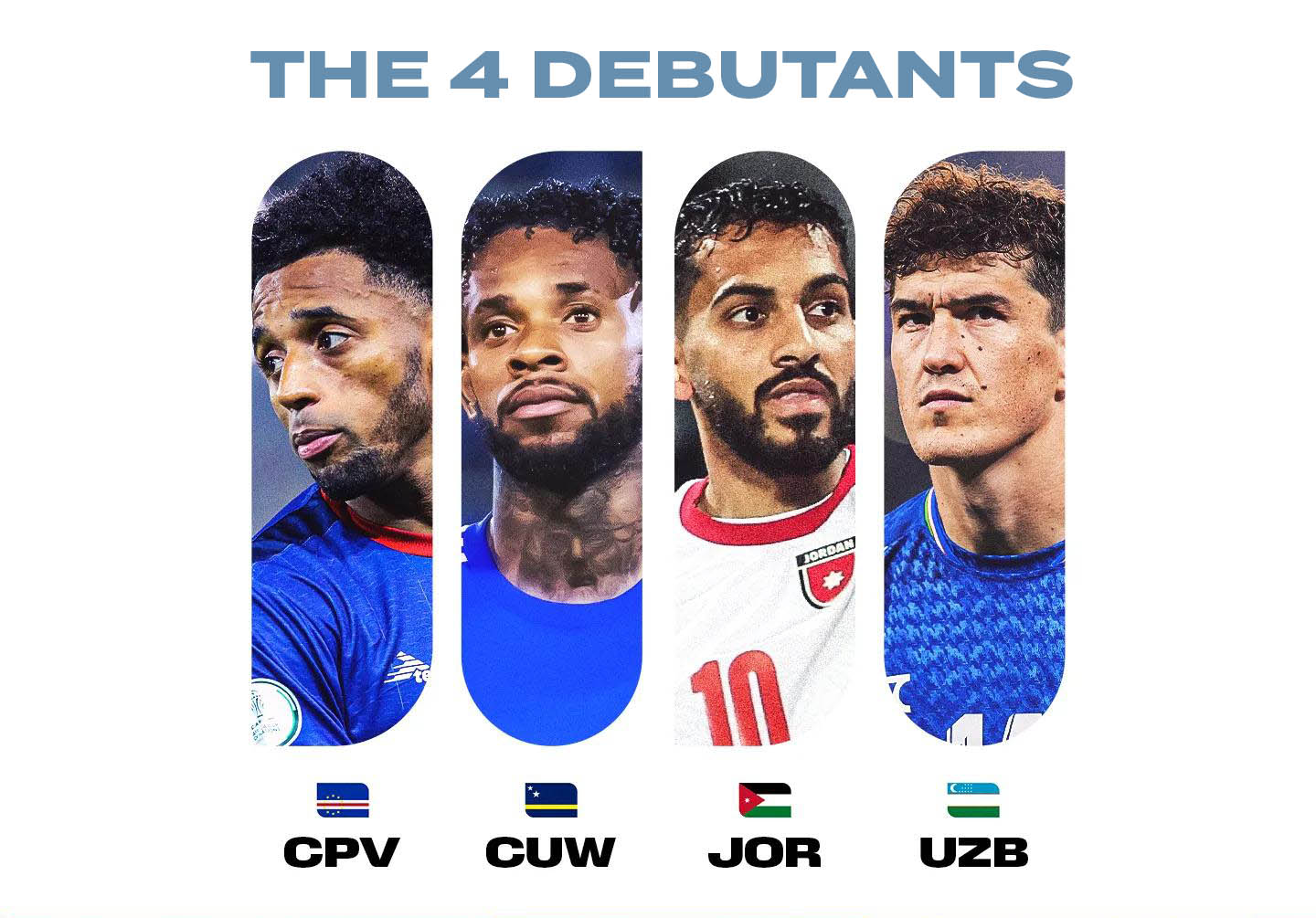
Cape Verde, Curaçao, Jordan and Uzbekistan will play at a World Cup for the first time in 2026. Stories like these make the tournament unpredictable, more colorful and especially exciting.
The expansion to 48 teams is already changing the character of the World Cup before the opening whistle. More places mean more matches, more stories – and more nations stepping onto soccer’s biggest stage for the very first time. In 2026, four teams will make their World Cup debut: Cape Verde, Curaçao, Jordan and Uzbekistan.
Cape Verde brings one of the strongest underdog stories of the tournament. The island nation off the west coast of Africa has only around half a million inhabitants – and came through a qualifying group with much larger and more experienced soccer nations. Especially remarkable: Cape Verde won the group ahead of Cameroon, an eight-time World Cup participant. Angola and Libya were also in that group. The decisive step came with a 3-0 win against Eswatini.
Curaçao is even more extraordinary: with around 156,000 inhabitants, the Caribbean island is the smallest country ever to qualify for a men’s World Cup – both by population and by area. Only a few weeks earlier, Cape Verde had held that record; then Curaçao went one step further. The real little sensation lies in the way they got there: the team went unbeaten in the decisive CONCACAF qualifiers and secured its World Cup ticket with a 0-0 draw in Jamaica. In stoppage time, a penalty for Jamaica was overturned after a VAR review – and just minutes later, the biggest soccer moment in the island’s history was complete. Add to that the special mix of the team: many players with roots in Curaçao, developed in Dutch soccer, led by experienced coach Dick Advocaat. That is how a small Caribbean island became a World Cup participant.
Jordan is not coming out of nowhere. Reaching the final of the 2023 Asian Cup was already a clear sign that something was developing there. At the center is Musa Al-Taamari, a quick, skillful right winger who has made his way in Europe – from APOEL Nicosia to OH Leuven and Montpellier, and on to Stade Rennes. In France, he has drawn attention especially with his pace, direct one-on-one play and assists. For Jordan, he is more than just the best-known name: he is the player who makes transition moments dangerous and gives an underdog exactly the kind of quality that can make the difference at a World Cup.
Uzbekistan is not a classic outsider either, but rather a long-overdue newcomer. In Asia, the team had long been seen as one of the strongest nations never to have reached a World Cup – with several painful near-misses along the way. In 2026, that barrier has finally been broken. What makes the team interesting is its mix of solid organization, growing youth development and individual players with international quality. Captain Eldor Shomurodov brings experience from Italy and Turkey and was the team’s key goalscorer in qualifying. Add to that Abbosbek Fayzullaev, a technically gifted creative player. Uzbekistan therefore feels less like a random participant and more like a team that has been working toward this moment for a long time.
For the ProXES betting game, this means: anyone who goes only by big names can quickly get it wrong. Debutants are harder to assess because there is little World Cup experience to go by. At the same time, teams like these often play with special energy. Maybe one of the newcomers will pay the price for inexperience. Maybe one of them will create the first big surprise. One thing is certain: these four teams make the 2026 World Cup bigger, more colorful and more interesting.
Image Source: FIFA, „FIFA World Cup 2026 debutants“, FIFA Digital Hub